
Thought leader
Blind Contours of the Classroom: Drawing to Understand
Nicholas Stewart | November 24, 2017
Thought leader
Nicholas Stewart | November 24, 2017
Nicholas graduated from Yale in 2017 and currently works at Jebbit. He was George Stewart’s student from 2009-2011 and his son since 1994.
Before I learned to sketch blind contours, drawing was an activity that I always assumed was similar to taking a photograph. As my family traveled when I was young, my father would often encourage my brother and me to pause and write or draw. Both were meaningful ways to record our experiences, and reflection during trips abroad was always an activity my parents (both teachers) insisted on. So drawings, I thought, were essentially mechanisms for capturing the appearance of an object, place, or person.
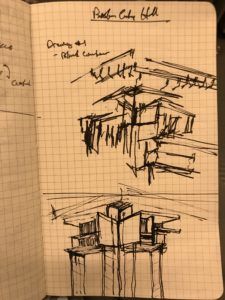
It wasn’t until I started taking architecture classes at Yale and learned about blind contours that I started to think of drawing as a fundamentally analytical practice. Blind contour drawings encourage the student to sit for a short amount of time and draw a building without glancing at the page. The goal of the exercise is to intensely sketch the building without great concern for the appearance of the marks on paper. It’s an almost impossible task. But the goal is to sit and stare at a building, working furiously to record all the details before your eyes, without once taking a look at the growing mass of scribbles in your notebook.
If anyone passing by were to glance over your shoulder, they’d probably think, “this is a crazy person, steer clear.” And at the end of your 15 minutes, the maze of lines probably won’t align exactly with the scene in front of your eyes. But if you take a moment to examine the drawing and reflect on the exercise, you’ll notice a couple wonderful things happen.
The first doesn’t have anything to do with what’s in your notebook. It turns out that simply by forcing yourself to look closely at a building and asking your hand and eye work together, you’ll notice hidden features that escape the customary gaze. You’ll also suddenly care less for the ornamentation of a building and focus more on the structure. Blind contour drawings have a way of allowing us to stop bothering with questions like, “what color is that wall and how can I create it with my pencil and paper?” Instead, we confront questions of motion and scale-like, “How do people move through this building” or “what’s more essential for my drawing, the windows or the wall itself?” These are more fundamental inquiries that allow us to understand the building on a deeper level.
The second miracle is that despite not looking at your page while composing the sketch, when you finally examine it you’ll actually have an easy time identifying which marks correspond to features in the building. The information might look like the ravings of a madman to your friends, but to you they make perfect sense. And what’s more, the marks represent details that you would have never noticed or recorded if you simply took a photo.
The point isn’t to paint a picture of the building– it’s to understand the building, to focus on structure, meaning, and not merely appearance. It’s ok to be messy and creative as long as there’s a method to the madness. As a student, there’s no better way to let go of superficial measures of success and embrace the most essential and relevant questions.
The activity also raises important considerations for teachers about what good information or data looks like. Maybe a mass of scribbles is a better means for a student to solve a problem than a clearly organized and aesthetic solution. Ultimately, the blind contour empowers students to own and articulate the meaning of their work. Only the person who drew can present the details of the drawing. The responsibility falls to the student to communicate their bond with the building and the information on the page. With a low stakes and fun activity, teachers can embolden students to look closely, create, and then share their art.
How can you use blind contours in your classroom? Try this activity.

Nicholas graduated from Yale in 2017 and currently works at Jebbit. He was George Stewart’s student from 2009-2011 and his son since 1994.
Explore our unique tour collections that bring learning to life across inspiring destinations.



