
Global Leadership Summit
Local Change, Global Impact
Jenna A. | August 4, 2016
Global Leadership Summit
Jenna A. | August 4, 2016
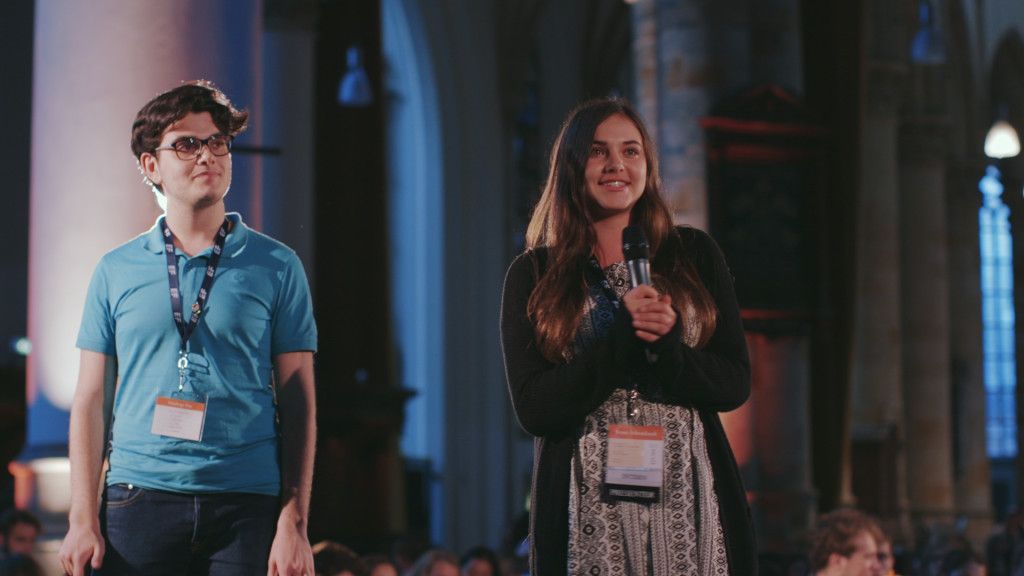
This article is part of an op-ed series from EF’s Global Leadership Summit Internship Program. The program provides high school students with a deeper experience at EF Summits by gaining valuable real-life skills through public speaking, journalism, social media and photography. We asked each intern to address a Summit topic that they were particularly drawn to. Below is what intern Jenna A. had to say about the power of individualization in storytelling.
Our individual stories matter. We all have our own life experiences that, for better or worse, make us who we are. As there is no universal understanding of human rights, there is also no universal definition of a violation. Which means individual stories of human rights violations can also not be generalized. My name is Jenna A. I’m a junior at Windward School in Los Angeles, California. This summer I was an intern at the EF Global Student Leaders Summit in The Hague, Netherlands. There we discussed the importance of preserving and fighting for our human rights, and how we can work to bring about change in our own communities. The Summit taught me about the value of emphasizing personal experiences when looking to raise awareness about human rights violations in an effort to help end them. I believe in the power of the individual’s story, so I set out to hear as many stories as I could.
A Story for Every Violation
“Suicide bombings in Baghdad shopping area have killed 126 people, including 25 children.”1
How does this headline make you feel? It highlights an ever-growing global crisis that can quickly make anyone feel powerless. Reports like this oftentimes leave people feeling fearful, overwhelmed and helpless to the point of saying ‘there’s nothing I can do about it.’
“Death Toll Tops 150 in Iraq Blast as ISIS Changes Tactics”2
The problem with these headlines is that they remove all personal elements of the tragic events. It merges every victim’s story into a single statistic, which sanitizes the unimaginable pain and horror that occurred on the ground. And while personal stories may be easier for an outsider to ignore when compared to sensational headlines, they carry an immense power. On the surface they may seem to affect fewer people, however intimate and personal descriptions of human rights violations are often more impactful to an individual reader. When considering how to tackle human rights issues, both locally and around the world, it is important we acknowledge that, “we as humans are hardwired to care, not about classes or communities of people, but about an individual.”3
When personalization is applied to telling these stories, outsiders hear intimate details of personal struggles and can create a deeper emotional tie by incorporating a name and a face to their understanding of the issues. Sheryl WuDunn, a keynote at the Human Rights Summit, states that this is hugely impactful. People are more likely to respond to an emotional connection than to a statistic. Studies support this idea, showing that “people feel as though they want to make a difference, but can’t with a thousand people.”4 University of Oregon Psychology Professor, Paul Slovic, conducted a study on the effectiveness of donor campaigns. He found that people were twice as likely to donate to a single child than two children because, “we cannot wrap our minds around two people as well as around one.”5 Hearing an individual experience, on the other hand, empowers others to take action for that one person. Individual stories make the immense challenge of protecting human rights seem more tangible. Through personal accounts, large issues become local issues. Human Rights violations are not perpetrated across every inch of the globe equally, but by sharing individual experiences, anyone can connect, empathize, and therefore become affected. “Small people make big differences, and small things add up.” (Hannah M., CA) “I feel really powerful. There is always a way to stop this and I am proud people have such strength.” (Gianluigi Z., Italy)
It is vital when facing the challenge of protecting Human Rights not to forget the individuals who are too often a part of these larger stories. Telling these stories, even if just locally, has the potential to contribute to the solutions for international crises. Individual stories prompt empathy, which in turn inspires passion and mobilizes action. After all, “we are all world citizens. We are all interconnected.”6 What happens when you combine a dedication to creating change with a passion for human rights? Check out more highlights from our last Summit! 1 CNN, July 4, 2016 2 Nicholas Kristof, EF Global Student Leaders Summit in The Hague 3 Wall Street Journal, July 4, 2016 4 Sheryl WuDunn, EF Global Student Leaders Summit in The Hague 5 Paul Slovic 6 Arun Gandhi, EF Global Student Leaders Summit in The Hague

Explore our unique tour collections that bring learning to life across inspiring destinations.



