
History
The Real Equator
Katie from EF | May 21, 2008
History
Katie from EF | May 21, 2008
The most interesting thing we learned from talking with equatorial dodgeball enthusiast Bryan Wojtowicz was that the “world’s first interhemispherical dodgeball game” took place at the “real” equator.
“Real equator?” I asked.
Wojtowicz explains:
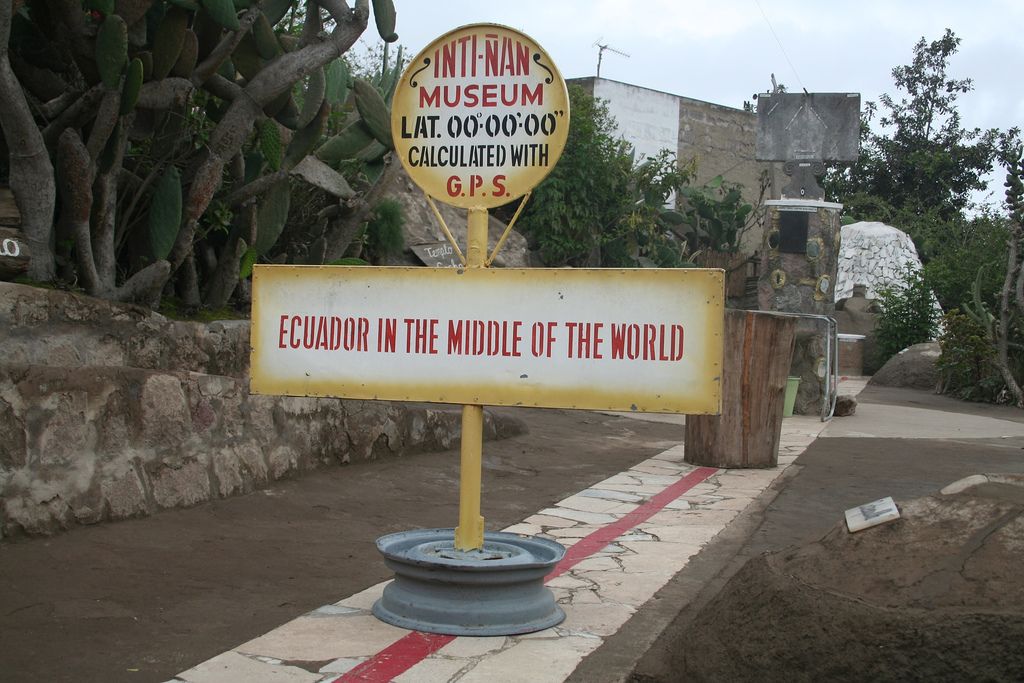
“We first went to what was called the real equator (outside Quito, Ecuador),” he said. “I don’t know if you know, but in the ’50s, they made a monument for what they thought was the equator. But, years later, with GPS technology, they found out that that was not exactly zero degrees latitude.
“Even locals down there don’t know that. So later in the ’70s, they recalculated it and found it was actually a few hundred yards in whatever direction. So this guy who happened to own land there kind of built a mini-monument as the real equator.
“And they have things there that prove that it’s the real equator, such as you can balance an egg, on the fat part of it, on a nail on the equator. … It takes a little bit of skill and time to get it perfectly, but I witnessed an egg standing on a nail. “Then they have things like a little portable sink, and when they put the drain right over the equator, the water goes straight down. And then when they move it 10 feet to the right, it goes clockwise; 10 feet to the left, it was counter-clockwise.”
Because the “real” equator has only a narrow space in which to play dodgeball, Wojtowicz and his pals re-created the game for their video project “at the fake equator, where the big monument is. … It kind of looks better, because it’s a wide area.”
When the Boston Globe first reported the Bryant University dodgeball game at the equator, writer Taryn Plumb interviewed James L. Davis of the Harvard-Smithsonian Center for Astrophysics in Cambridge about the physics of playing at the equator.
“I couldn’t believe that the person who wrote that article actually asked a Harvard University professor,” Wojtowicz said. “He must have thought that was pretty ridiculous.”
Davis said that he didn’t think the students would be able to see or feel any equatorial effects. That’s partially true, but Wojtowicz insists he saw evidence of the equator.
“No, you couldn’t feel it as we were playing,” he said. “But another interesting thing, kind of like with the egg, when you’re standing on the equator, the gravitational forces on your body are stronger than when you’re just 20 feet away. So, for example, they had us hold our arms in a fist like about at our head, and then they asked us to have a friend to try to pull your arms down. It’s much easier for that person to pull your arms down on the equator than it is 20 feet either way.
“So, say, if you’re standing 10 feet away from the equator throwing a ball, it’s easier to throw it away from the equator than it is if you’re standing on the equator. So there is some science behind it. If ‘ MythBusters‘ did something, they could figure it out, I guess.”
Photos: T-Oh! & Matt via Flickr (equator) and Bryan Wojtowicz (egg)

Explore our unique tour collections that bring learning to life across inspiring destinations.



